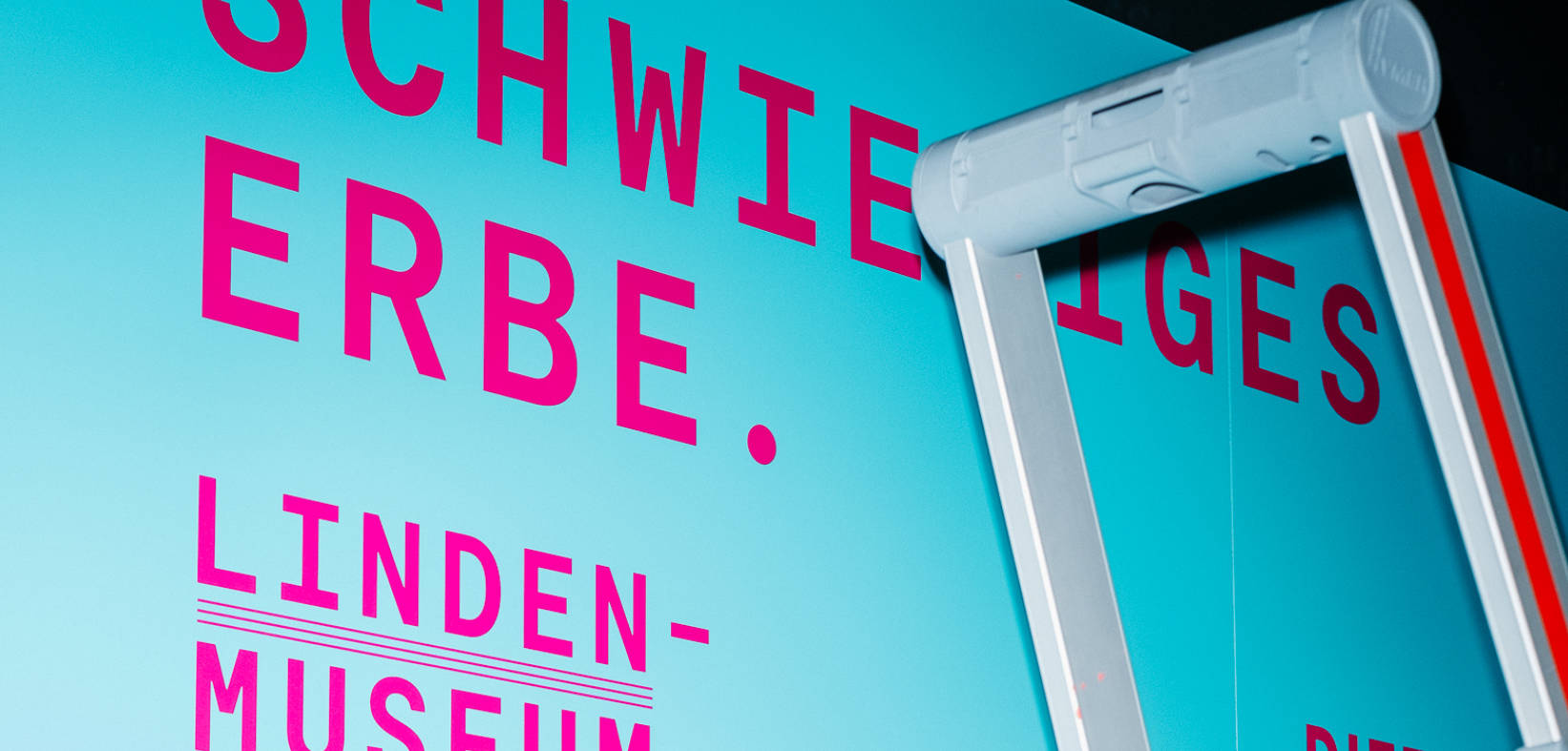
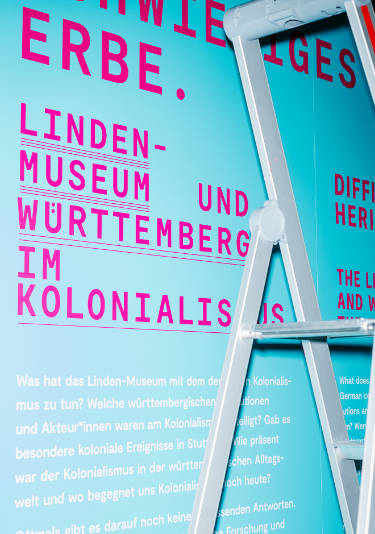
Vor einem Wandpanel der Sonderausstellung "Schwieriges Erbe" steht eine Leiter

Jobs

The Linden-Museum Stuttgart is the only state museum for ethnology in Baden-Württemberg. With its world-class collections from Africa, the Americas, Asia, Australia and Oceania, it is one of the most important anthropological museums in Europe. In addition to its permanent exhibitions, the museum regularly presents special exhibitions on changing themes that attract national attention.


In front of and behind the scenes, more than 60 employees work together to accomplish the museum’s many tasks. As a state museum, the Linden-Museum offers attractive working conditions such as flexible working hours within a flexitime model, the possibility of mobile working and a subsidy for season tickets for public transport by the State of Baden-Württemberg (JobTicket BW).


We value diversity and therefore welcome all applications – regardless of gender, nationality, ethnic and social origin, religion/belief, disability, age and sexual orientation and identity. Severely disabled applicants (f/m/d) will be given preferential consideration if equally qualified.

Contact

Logo des Linden-Museums

David Scherer

Phone +49.711.2022-431
Mail scherer@lindenmuseum.de

Senior Curator (f/m/d) for the Africa Department

The Linden-Museum Stuttgart is one of the important world culture museums in Europe. We are looking for a full-time (100%) Senior Curator for the Africa department, for a limited period of two years (with a possibility of extension) starting as soon as possible. The position will be graded in pay group 14 of the current collective agreement for the Federal States in Germany (TV-L).


The Linden-Museum’s Africa collection comprises around 40,000 objects, including important collections from Cameroon, Congo, Tanzania and Togo. The Museum currently manages various projects and relationships pertaining to the legacies of colonial collections from these regions. In addition, the museum is engaged in dialogues on restitution and repatriation with various African nations and communities.


Your responsibilities will include representing the Africa department in curatorial, scientific, and organizational matters in cooperation with the head of the “Collection and Research” department and the director. This includes, in particular, the care and inventory of the collection, the further development of the digital collection, the development and implementation of dialogue projects with representatives of source communities and diverse urban audiences, the conceptualization and implementation of permanent and special exhibitions, including accompanying programs and publications, as well as active participation in the new conception of the museum. Other tasks include supervising staff associated with temporary projects, including interns, as well as processing inquiries relating to the department. 


Candidates should have completed a university degree (Master or equivalent) in cultural anthropology or a related field with a focus on Africa. A PhD is desirable. We expect proficiency in English and another language relevant to research in the region. Proficiency in French is an advantage. Proficiency in German is not a prerequisite, but we expect your willingness to learn the language. Previous extended stays in Africa are desirable. 


We expect candidates to have an interest in contemporary developments and post/decolonial discourse. We also expect proven practical experience in interpersonal and intercultural communication. We will privilege candidates who have experience conducting dialogue programs or running creative projects with representatives from source communities and/or their diasporas.


Candidates should have the ability to work in a team and a strong interest in interdisciplinary and audience-oriented practice. They must be proactive, committed, and have good time management skills, and the ability to manage multiple projects simultaneously.


We value diversity and therefore welcome all applications – regardless of gender, nationality, ethnic and social origin, religion/belief, disability, age, sexual orientation and identity. Severely disabled applicants (f/m/d) will be given preferential consideration if equally qualified.


Please send your application documents by post or in digital form (as a single PDF file) by December 1st , 2025 at the latest to the Board of Directors of the Linden-Museum Stuttgart, Hegelplatz 1, 70174 Stuttgart or to personal@lindenmuseum.de.


For further information on the contents and requirements of the position, please
contact Prof. Dr. Inés de Castro, Museum Director, at decastro@lindenmuseum.de or
Tel. +49.711.2022-400.


Please note that application documents will only be returned if a sufficiently stamped
and addressed envelope is enclosed.


Your information will be stored and processed as a part of the application process. For details, please contact personal@lindenmuseum.de.

Ein Blick hinter die Kulissen

Welche Schritte braucht es, bis eine Ausstellung steht und wer arbeitet alles in einem ethnologischen Museum? Bei einem Praktikum im Linden-Museum Stuttgart kann man einen Blick hinter die Kulissen werfen. Durch die aktive Mitarbeit in unseren Abteilungen können wertvolle praktische Erfahrungen im Museumsalltag gesammelt werden.


Praktika werden grundsätzlich in den Abteilung Bildung und Vermittlung, Presse- und Öffentlichkeitsarbeit, Ausstellungskoordination, Personal und Finanzen, Sammlung und Forschung sowie Restaurierung (nur studienbegleitende Restaurierungspraktika) angeboten.

Im Linden-Museum können folgende Praktika absolviert werden:

Bitte senden Sie alle erforderlichen Unterlagen als pdf an personal@lindenmuseum.de (Anschreiben, tabellarischer Lebenslauf, relevante Zeugnisse, Angaben Zeitraum und evtl. Abteilung; bei Pflichtpraktika: Auszug aus der Studienordnung, Immatrikulationsbescheinigung). Wir geben Ihnen Rückmeldung zu Ihrer Bewerbung, sobald wir geprüft haben, ob die gewünschte Praktikumsstelle ermöglicht werden kann. Bitte haben Sie Verständnis, wenn wir Ihre Bewerbung möglicherweise nicht berücksichtigen können.